
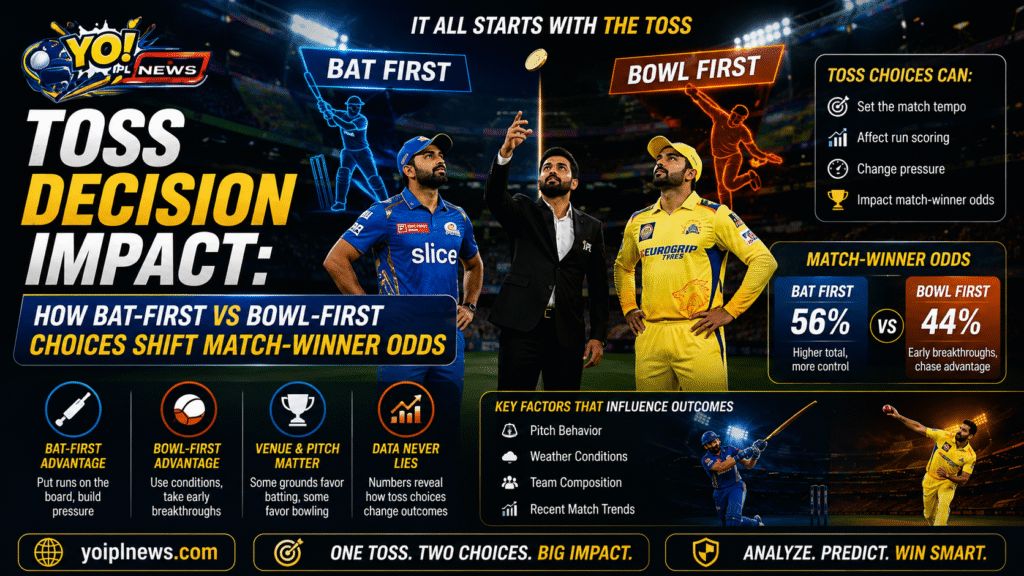
Watch the odds board closely right after a toss announcement, and you’ll notice something interesting — the match-winner price doesn’t just adjust for who won the coin flip. It moves based on what they chose to do with it. Sometimes barely at all. Sometimes enough to change the favorite entirely. A toss decision shifts match winner odds because bat-first and bowl-first choices carry different implied advantages depending on the venue, conditions, and each team’s known strengths — and the market prices that difference in almost real time. Understanding why that shift happens, and how big it tends to be, is more useful than just knowing who won the toss.
Why the Decision Matters More Than the Toss Itself
Winning a coin flip is random. What a captain does with it isn’t. That’s the key distinction the market is actually reacting to. A team electing to bowl first at a ground with a strong chasing record is signaling something the market already half-expected — and the odds adjustment reflects confirmation, not surprise. But a team choosing to bat first at that same ground, going against the grain, tends to move the market more sharply, since it’s a decision the odds compilers didn’t fully price in beforehand.
This is why identical tosses at different grounds can produce completely different-sized odds movements. The toss result is the same kind of event everywhere — a decision is not.
Reading the Size of the Shift
Venue history strength. Grounds with a strong, well-documented bias toward chasing or setting totals see bigger odds swings when a captain goes against that pattern than when they follow it.
● Pre-match pricing already accounted for the toss. If oddsmakers already priced in an expected decision, the actual announcement barely moves anything. Surprises move markets; confirmations don’t.
● Team-specific chasing or defending record. A team known for strong chases getting to bat first (rather than bowl and chase) can shift odds noticeably, since it removes their preferred path to victory.
● Conditions on the day. Overcast skies, dew forecasts, or a visibly dry pitch all interact with the toss decision, sometimes amplifying the odds movement and sometimes dampening it if conditions make the decision more predictable.
A Simple Way to Read It
The gap between pre-toss odds and post-decision odds is basically the market telling you how much weight it puts on the bat/bowl choice at that specific venue, for that specific matchup. A small shift means the decision was expected. A larger shift means the market is genuinely recalculating the game’s likely shape.
This is more useful than just watching who won the toss, because two matches can have the same toss result — home team wins — and produce completely different odds reactions depending on what that team actually decides to do next.
Bat-First vs Bowl-First: What Each Signals
Choosing to bat first usually signals confidence in the surface holding up, or a team playing to a strength — a strong top order, a venue known for tricky night conditions, or historical data suggesting totals get harder to chase later. Markets often interpret this as a team backing itself to set a defendable total rather than relying on chasing under pressure.
Choosing to bowl first typically signals either strong dew expectations, confidence in chasing under lights, or knowledge that the pitch is expected to assist bowlers more as the match progresses. This is the more common modern choice in day-night cricket, which is partly why it moves markets less on average — it’s increasingly the expected decision rather than a surprising one.
Why This Actually Matters for Reading a Match
The size and direction of the odds shift after a toss decision often tells you more about how the market rates a matchup than the pre-match odds alone. A sharp swing suggests the market is genuinely uncertain how the decision changes things. A minimal shift suggests both the toss winner’s choice and its impact were already well understood before the coin was even flipped.
Paying attention to that reaction — not just the decision itself — is a more precise way of understanding where the market’s confidence actually sits once a match begins.
Final Thoughts
The toss gets treated as a footnote by a lot of casual viewers, but the market clearly doesn’t see it that way. The size of the odds movement after a bat-first or bowl-first decision is a direct read on how much that specific choice matters at that specific ground, against that specific opponent — and that’s a more precise signal than the toss result on its own.
FAQs
Why do odds move after a toss decision, not just the toss result?
Because the decision — bat first or bowl first — carries an implied advantage based on venue and conditions, which the market prices in real time.
Does a bigger odds shift mean a more significant decision?
Generally yes — larger shifts indicate the market didn’t fully expect that choice, while smaller shifts mean the decision was already anticipated.
Is bowling first always the “expected” choice in modern cricket?
It’s increasingly common in day-night matches due to dew factors, which is part of why it tends to move odds less than an unexpected bat-first call.
What venue factors affect how much odds move?
Historical chasing or defending bias at that ground plays a major role in how sharply the market reacts to a toss decision.
Can two matches with the same toss result have different odds reactions?
Yes — the actual decision (bat or bowl) matters more than who won the toss, so identical toss outcomes can produce very different market movements.